Translate

Showing posts with label South America. Show all posts

Sunday, 11 January 2015

Lost in Guyana

We liked Guyana. Despite the consistent warnings of Guyana being a bad and dangerous place, we never once felt threatened or had a bad experience. However, our maps and information weren't good, and we were consistently lost or confused. 

Of course, being lost can lead to some wonderfully serendipitous experiences, and that's how our final day in Guyana was. 

Our first confusion was in Guyanas capital: Georgetown. We arrived on a Sunday. Our GPS didn't have a specific Guyana map, and the Garmin South America map seemed to have nothing to do with reality. Pegasus Hotel is recommended as a place for overlanders to 'pamp', but we couldn't find it until I asked a young boy (about 10yrs). "There" he said, pointing. We were so close, it was almost embarrassing!

The next day, Monday, we walked into the city centre. It was dead, nothing was open. Apparently it was a public holiday, for a Muslim celebration. Guyana is a country of multiple faiths and they have holidays for all of these religions, which makes for a lot of holidays. 

With everything closed it only took us about an hour to explore the centre on foot. We thought the old timber buildings were quiet charming and there was a scenic mix of renovated buildings and buildings needing repair. (Honestly, I think they should be fixing a few of of major buildings before its too late). 

With nothing else to do in Georgetown, we left. Or, we tried too. We couldn't t find the road out. We needed to first drive to Linden, but our GPS didn't have a clue and we never saw a single sign pointing us in the right way. Eventually a taxi lead us to the right path. (Free, he was going that way). 

From Linden onwards there were signs to Lethem (the next major destination), but ironically, there was also only one road to take. Lethem is the border town, next stop Brazil. 

Along the way to Lethem I thought it'd be nice to visit a place famous for River Otters. But, once again, there were no signs. We never found the turn off. 

Finally we saw a turn off for a list of places (nothing we'd heard of) and a picture of a river otter on that same sign. So, we turned off. This is a part of the world  called the 'Rupununi', and it's quiet spectacular. Mostly its open country but we reached a path though forest impossible for our vehicle height. We turned back. But, there were dirt tracks everywhere and at one point H accidentally took a different path to that on which we'd come. 

It was late in the day when we reached an Amerindian village called Nappi. We decided to stop for the night and we pulled up beside a shelter at the sports field. 

After a few hours a man came to see us, he was the village 'captain', and he informed us that to drive through an Amerindian village we should first get permission, and to stay we also needed permission and to pay. It was all okay, he gave us permission and we paid $1000 (local dollars, or $US5). He then stayed and answered all my questions about Amerindian life. 

In the morning, trying to go from Nappi to Lethem, we got even more lost and found ourselves at another village. (These villages are very scattered with houses not very close). At the school I found some people and asked for help. A man told us to wait as he was leaving (on motorbike) soon and we could follow him. We are very lucky this happened... With simple directions we might still be wandering around Guyana's Rupununi!

Getting lost allowed us to see some beautiful countryside, and learn a bit about Amerindian life too. I'm glad we wandered off the beaten track and got lost for a day. 

Thursday, 11 December 2014

Waiting in French Guiana

Although we've been in French Guiana for about a week and a half, there isn't a lot we can tell you about.

In our first town over the border, St Georges, we found a wonderful French Patisserie. Small, but good. 

Then we drove to Cacoa, which is a settlement of Hmong people from Laos. The guide book tells of it's wonderful Sunday fresh produce market and a butterfly place, but it was Wednesday that we went and, unfortunately, pretty much everything was closed and there wasn't anything interesting that we found. 

Next we went to the capital, Cayenne. Cayenne isn't a big city and it has some nice coastal areas. At the visitor centre we put our names on the list for tickets (Free) to see the shuttle launch scheduled in Kourou Space Centre, on Thursday, December 4. But for the tickets we'd have to return to Cayenne on the Tuesday. 

We left the city and headed to Kaw. Unfortunately I had a head cold. We tried a hike in the forest, but I really wasn't up to completing it. I did like the forest, the clear stream and the little leaf like frogs that hopped through the leaf matter. We also met some tourists (in a hire car) and shared a boat with them to visit the town of Kaw, but it really wasn't very interesting. You can also do wildlife spotting boat tours there but I wasn't well enough to commit to a few hours on a boat. 

Returning from Kaw we stopped 2 nights in the town of Roura. I was most delighted that a woman there had a pet monkey. Then I was horrified to learn that people shoot the mother monkeys so as to orphan the baby and take it as a pet. 

Back in Cayenne, we got our tickets for the shuttle launch and came to Kourou. We are still in Kourou because the rocket launch (it's to launch some satellites) keeps getting postponed to the next day. So, we are really doing a lot of sitting and waiting. 

Once the shuttle launches and we've seen that, we hope to visit the 'Salvation Islands' (Illes du salut), we can't do it prior because currently they are closed to visitors due to the shuttle launch. So, for now, this has to be a waiting game, or we skip French Guiana's main 2 attractions. 

Update:
The wait is over
Two days after the scheduled launch date it happened. We were all loaded onto buses and taken to the viewing site. The launch itself was quite spectacular. It was 'Ariane Flight VA221', and, I hope I get my terminology right, the Ariane 5 mission was to launch 2 satellites. One for DirectTV to deliver satellite TV to the USA and Latin America, and the other an Indian communication satellite. The mission was successful and fireworks will look pitifully small forever more, in comparison. Ironically, we'd met some international yachties and we were all chatting so much that we almost missed seeing the 'lift off'. 
Hendrik captured some great photos, but I'll have to put them up later. 

Hollywood lied!
The launch means that the next day we were able to visit the Salvation Islands. They were a brutal part of the former French penal colony that was here in French Guiana. You can go across on a Catamaran for a day or stay overnight. We went just for the day, which is enough to visit the ruins, hike and see some wildlife. 

The islands are also famous for the legendary character 'Papillon' who was quite the escape artist. There's an old Steve McQueen movie about Papillon (it's called Papillon too). The movie is very good. In the movie Papillon makes one of his escapes by making a raft of a sack of coconuts and throwing himself and the raft from a cliff on Devils Island into a rough sea below. But!, H and I didn't see any suitable cliffs for this. Did we just miss a bit of the island? Or did they just make that up for the movie? 

The island ruins are good to see, but unfortunately there was no information in English so if I hadn't seen the movie it all would have been just a pleasant day trip for me, but not interesting. For us there was a more spectacular element to the islands: at lunch time a bright red and blue Macaw visits the restaurant and steals food from people's plates. He seemed to like cheese... H said its because he's a French Macaw!

Update later again:
Finishing up in French Guiana
I still haven't found a working Internet connection to upload this post so I keep adding to it. 
Having done what there was to do in Kourou we headed to the border. We stopped along the way at some wetlands (Pripri) , stayed overnight at a (free) camping area on a creek, and in the morning did a 3km hike in the Pripri wetlands. We saw a few birds and it was a nice hike.
Then we continued to the border town of Saint Laurent du Maroni. It has what was the former Transportation Camp where they processed and imprisioned convicts sent to the penal colony. The facility here is in very good condition and in the transportation camp grounds and around town there are good information boards with information in French and English (finally!, thank you). 

Finally, it was time to leave French Guiana and enter Suriname. 
The Araine 5 going up!

H trying to escape from a cell 7n the old prison.


Some of the old prison buildings were in good condition.

The gate to the Transportation Camp, Saint Larent du Maroni. 

And finally, the 'French' Macaw that likes to eat cheese and chicken salad. 

Thursday, 27 November 2014

From Brazil to French Guiana

Anybody with a bit of knowledge of this part of the world might realise that we've headed up the coast of Brazil, going North then West, rather fast. We had a few good reasons for this: 1) Brazil only allows a 3 month stay (unless you can apply for an extension) and our time was running out. Plus we wanted to have a little of our 3 months left to re-enter Brazil to get from Guyana to Venezuela (later on). 2) The last 110kms out of Brazil, going to French Guiana is dirt, and we wanted to pass it before the start of the wet season, or, if we failed that, we might need those extra days we'd already been keeping. 3) French Guiana has a major rocket launching facility and we hope to see a rocket launch scheduled for early December.

So, from Belem we took a cargo ferry to Macapa. I've written about the process of sourcing a suitable boat on my Brazil Overlanding notes page for any interested overlanders. 

The cargo boat took 40 hours (2 nights) to cross the mouth of the amazon river, passing various islands on the way. H insisted that he'd sleep in Blac, I took our hammock to the top deck where everyone else was sleeping (about 10 men, almost all staff). 

On a couple of occasions H was in Blac (the camper), down on the deck, when we hit very rough waters. It was scary for both of us and H says that waves hit the back of the camper and water came in. I get sea sick, so I was taking ginger pills and just holding on (ginger is wonderful, I wasn't sick). 

The scenery was interesting, lots of people live on the waterfront in basic shacks and the main industry was obviously timber. We also saw many boats carrying baskets and making regular stops. These, we believe, were collecting Açai. It's a miracle food from the amazon that you'll find I'm many western health shops. 

On the wildlife side we saw dolphins twice. We think the first sighting was a pink river dolphin!

When we got to Santana (Macapa) we had to wait all day to unload. First they had to unload, by hand, enough stock (rice, salt, flour, eggs, corn, farinha) for  H to manoeuvre Blac into a suitable position, and then we had to wait for the tide to go out enough. Finally we unloaded, and discovered that across the river was a very pretty historical area of protected houses connected by boardwalks. 

Macapa itself was a pleasantly surprising city. We visited the fort and had Açai (it really does make you feel good), before starting north west again. 

Late the next day we arrived in Oiapoque, the place from which you get your passport stamped and leave Brazil. From Oiapoque to Grench Guiana they've built a wonderful bridge, but, years later they still haven't opened it, so you have to pay a ferry to take you across! 

At immigration (Policia Federal) we discovered that despite rushing to come North we'd been wrongly processed as exiting when we entered São Paulo airport. We talked things over with the man and eventually he was able to fix things a we were allowed to exit Brazil (where we officially never were!).

By now it was just on 6pm and the ferry was closing for the day. Oh well, at €200 for the boat we hoped that by waiting until the next day we could share the expense, so we waited. But then we found out that only 3-5 vehicles cross each week and the next reservation was in 3 days time, so late on the next  day we paid the 200, and crossed. 

The ferry journey from Oiapoque to St Georges is actually upriver and takes about 45 minutes, and the scenery is nice. 
In St Georges we got directions and headed straight to immigration, but they'd just closed (6pm)! So we parked by the river overnight and enjoyed the scene with a few drinks and sardines on toast. We'd left Brazil, and made it to French Guiana!

photos:
We are loaded and ready to leave Belem, but they are still stacking freight.

EVen a basuc lifestyle in Brazil seems to have a satellite TV dish!

Our path, acording to the GPS,  through the mouth ofthe Amazon River

The lovely historical boardwalk area of Santana (Macapa)

H, testing the hole in the bridge before we drive across, on the road to Oiapoque. 

The final ferry from Brazil to French Guiana! 

Sunday, 16 November 2014

Travelling from Jericoacoara to Lençois Maranhenses, day 1

Into Jericoacoara 

Is driving your own vehicle into Jericoacoara really not allowed? The Lonely Planet Brazil guide says traffic is restricted, but despite having travelled through Jeri yesterday, we still aren't sure about the regulations.

On arrival into Jericoacoara we were instantly stopped by young 'parking attendant' men who told us we had to park there and couldn't drive into town. But, their demeanour wasn't that of people enforcing a regulation. No, it was more like desperate tourist touts trying to get you to park with them, hire a taxi, buggy or horse from them, book a room with them. We didn't trust that what they were telling us was at all true. 

We tried to tell them that we wanted to keep going up the coast and for that we needed the road, which we thought was accessible through town, and for the night we'd like a campsite. But, the young man was so full of 'push' to get us to parking there that he wasn't even listening or trying to help us. H lost his temper, raised his voice, and then we drove of, with the young man threatening that he was calling the police, and his colleagues giving hand signals that we'd be handcuffed. (Really? For driving into a town to find the way north? .... we've seen Brazilian police ignoring much more dangerous activities.)

We parked at the fence before the big dune, the one that you are supposed to climb to watch the sun turn emerald green as it dips below the horizon. We climbed the dune with the hordes of tourists and watched the sun disappear behind a cloud before it reached the horizon. Oh well. 

H, needing the loo, headed back to the motorhome sooner than I did. He was greeted by the police who told him that we didn't have to park with those parking attendant people, but nor could we park overnight in town. We could, however, drive North up the coast by going through the fence opening just near where we were and camp anywhere we wanted to, North of the big dune. I got there not long after (I'd deviated along the beach), and off we went. 

We drove 6kms before we found a good place to stop overnight. It was between fishing boats. Unfortunately, this all meant that we didn't really get to visit Jericoacoara. I would have liked to, but circumstances meant we had left town rather soon. First impressions made it seem just to touristy, so I think we'd feel that it was all too pushy. 

photos: Travelling the dunes to Jericoacoara; Watching the sunset from the sunset dune at Jericoacoara; Our beach camp (next morning,  boats had gone fishing); the dune buggy's are popular for travel along the beach, they have a combi 1.6 engine and have the eV advantage of being light.

Tuesday, 11 November 2014

Price of fresh local fruit, roadside

We are enjoying a lot of fresh fruits as we drive through Northern Brazil. An added bonus is that not many foreign tourists would pass on these roads and even less would be stopping to buy fruits, so the stall holders haven't yet developed the common philosophy of 'charge 3 times the price to the overly white person who talks funny'. Or, if they are doing this, it's still cheap!

The fruit is wonderfully fresh. So what do we get? (Rs = Brazilian Reales, $ = USD)

5 Bananas + 1 Honeydew melon = Rs2 ($0.80)
3 Medium pineapples (H says they are large by European standards) = Rs5 ($2)
4 large Mangos = Rs2 ($0.80)
6 Mandarins = Rs2 ($0.80)
1 Jackfruit, ripe for eating, about 2kg = Rs5 ($2)
1 big Papaya (Pawpaw) = Rs2 ($0.80)
Fresh roasted Cashew nuts = Rs34/kg ($13.50/kg)

Not only are the prices wonderful, the fruit is so much nicer than what we get in the grocery shops in Europe and Australia. So, we are loving the fruits!

In the photo below, H is holding a Jackfruit that he picked himself, it's big! Alas, he picked it too green and it wouldn't ripen. (Apparently the leaf nearest the fruit should be turning yellow).

Monday, 10 November 2014

Beautiful free beach camps in Brazil

We've parked on or right in front of many wonderful beaches in Brazil. There's not many people overlanding here, and there isn't a camping culture either, so there aren't many 'campgrounds', and beach camps are pleasant compared to fuel stations.

Heres a spot (at the thatched roof shelters) we found just the other day. While we were there (overnight) we were the only people there, although plenty of people walked past on the beach. It was at a beach town called Tamandaré, in the state of Pernambuco.

When I went for a walk along the beach I found the lovely church, right on the beach!

Tuesday, 4 November 2014

How we got to go to a small town Rodeo-Circus

We've had some wonderful Brazilians sharing their world with us lately and each of these told us that we should go to the Canyon of São Francisco River, which I've also heard called Xingo Canyon. They each showed us spectacular photos of a vivid green river flowing through a steep canyon, on google. 

So, we detoured about 200kms off the coast to the canyon. We arrived late in the day so that we could do a morning boat cruise. Unfortunately, it rained in the morning and it was too grey for nice green waters. But the boat trip was fun, and the swim very refreshing. 

It was a 3 hour tour and after we decided to grab lunch down the road. We stopped at a restaurant in a small town where the barbecue smelled good. H ordered, or at least he thought he did (our Portuguese is lacking), and he was told we'd have to wait while they cooked it. 
When a waitress later came to ask if we wanted anything, he said 'yes, lunch, but we already ordered'. She asked 'who with'. H pointed at the other woman. Off she went. We waited, still no food. The other woman came to wipe our table and asked if we wanted anything else. 'Just lunch' said H. She left, we waited. I was reading a novel. We think we waited at least 1.5 hours, then another table that sat down after us received meals and so we just got up and left. We bought the Brazilian equivalent of Chico rolls and sausage rolls over the road and kept driving. 

Just out of town we stopped at the rodeo grounds because there were horses and trucks gathered. It was some kind of camp-draft type event, a display of working cattleman on horseback skills. We watched a few times while 2 men on horseback would grab a steer by the tail and wrench it to the ground. It was quite thrilling and we even got some good photos. 

But, the day still had more hours, we hadn't travelled far, and this event had no-where to sit (unless you brought a horse to sit on), so we kept travelling. 

Later, the sun was getting low and we saw a small town off the highway. We've found these towns can be good places to stop, so we pulled in. As soon as we turned off the engine about 20 kids surrounded us. And questions began. Then adults came, for 2 hours there was a constant stream of lookers and questions. There was an event set up, some called it a rodeo, others a circus, and we were invited to attend, and advised to park beside it. 

I (Ali, the Aussie) grew up in the country. I've been to a few camp-drafts and rodeos but I've never seen an event like this one. That evening there was only one beast that came out of the shute being ridden and the rider lasted about 1.5 seconds before being thrown. But, riding bulls wasn't what this event was about. 

The beasts used weren't big, neither were they bulls but a selection of steers and young cows. They'd release a beast into the yard (almost circular, of maybe 12 to 15 metres across) where 3 men waited. These men would torment the animal by waving red flags in front of it (you will be thinking of matadors now, but it was nothing like that). The animal would get stirred up and charge at the red cloth. And then, they'd drop the cloth and the steer/cow would charge at the ground or a man. But these men were bold and athletic, and missing teeth already. 
A man would lurch at the beast, with the crowd gasping, leap into the air and land on it's back, with the crowd now smiling at the sight of the man sitting on the beast facing its rear. At this point the beast looked confused!
At other times a man would ride between the beasts big horns, sometimes the animal would successfully pin the man to the fence but always another of the men would come in with the red cloth to bring the beast away from the fence before the first man got too badly damaged (I'm sure it still hurt). 
One man would often get onto the ground (knees and forearms on the ground) with his bum daring the beast to charge it, and as the bull came forward another man would use the first mans back as a jumping platform to land on the beasts back. Distracted, the animal would cease it's charge, again seeming confused. 
One man (and I'll use an expression from home to say "he's as mad as a cut snake!"), had legs like springs and wore a red shirt. He'd kneel a few metres in front  of a beast a walk on his knees towards it, slapping his chest in challenge. Then, when the beast was close enough he'd roll forward landing himself to ride on the beasts neck, facing backwards. 

In part I felt sorry for these animals for being tormented like this, but it was extremely entertaining. The animals were not physically hurt in this event (men were, we saw the red shirted mans back as he headed to the river the next morning (to wash)), and the animals did seem healthy and well fed. The cattle were even used to the drill: when their time was over, the gate controller would slap the gate loudly and the beast would stop looking for what to charge next and calmly walk into the back pen. Show over. 

In contrast, animals were injured in the cattleman display we saw earlier (at the other town), but those skills being practised there were real parts of working life for cattleman not just here but elsewhere in the world too. That event wasn't for entertainment (thus, no entry fee and no seating) but for competition of real working skills. 

H and I felt very lucky to have stumbled on both these events.


Sunday, 26 October 2014

Sleepless nights in Brasilia

If it wasn't on our route we wouldn't have bothered to go to Brasilia, and I'd say that's about the status it deserves.... stop if you're in the area, otherwise don't bother. 

Fortunately, camping is possible at the Hostelling International hostel, and you can leave a motorhome there and easily and inexpensively catch a bus into the city centre for sightseeing. 

Brasilia is the capital of Brazil. It's famous for architecture. Unfortunately we didn't find it to be a very welcoming city and that spoiled it a bit. The guy at the hostel reception was very disinterested, and in the city centre it was difficult to get tourist information, and generally we didn't feel that like tourism was of any interest to the city. (Maybe it's not, I don't suppose it has to be). 

At the same time the hostel was hosting some kind of youth political event. There were well over 100 tents and the hostel was full. The youth didn't sleep and consequently, neither did we. On the second day the ladies showers smelled like a urinal, the toilets were at the other end of the building so we can guess what was going on there. They were a nice group of youth, but I wished the hostel had a noise curfew. 

We weren't the only overlanders in Brasilia. On the second day an old retired French couple arrived and on the third a French family (parents and daughter) from Martinique (Caribbean island, part of France) arrived. We enjoyed meeting the family as they had come south from the Guyanas, and that's where we are heading. 

Wednesday, 22 October 2014

Brazilian drivers are crazy!

Brazilians, in general, are lovely people. I actually think that they might be about the friendliest people in the world. BUT, put them behind of the wheel of a motor vehicle and they think they're Airton Senna (famous Brazilian race car driver).

To put it another way, I actually think that Brazilians are inconsiderate drivers. They don't mind pushing other drivers off the road to overtake, and to me that's quite rude. 

This isn't to say they are bad drivers, they are actually very good at driving, just not good at considering other drivers or obeying road rules. 

Okay, we had a bad morning on the road. Let me explain. 

Brazilians overtake slower drivers whenever they can: double line or solid line on the right side? No problem. Crest of a hill or bend in the road? No problem.  Roadwork zone with speed limit at 40km/hr but slowest vehicle (which they want to overtake) travelling at 80km/hr? No problem. Police car slowing things up in one of the above problems areas? No problem, Brazilians will overtake police car in road zone on a bend too (and the police won't do a thing). The truck you want to overtake currently overtaking another truck? No problem, there's a generous road shoulder that can be utilised to pass both them (don't worry that technically this road has just one lane going each way). 

Here's the two events that happened today to us. 
Event #1: we were heading up a hill on a road with one lane travelling each way. Suddenly, over the top of the hill appeared 2 trucks coming towards us. (Remember, there are just two lanes, one going each way). There wasn't enough time! H slowed and got over into the road shoulder (hard and generous enough). Phew! But, then we couldn't re-enter the road immediately either, because the bus behind us (which had to have seen us forced off the road) was using the opportunity to overtake us in the right-hand lane. (driving is on the right hand side here). 
Of course, these drivers don't mind pushing others off the road, but, as ours is a rather top heavy vehicle, it's not a good feeling for us. 

Event #2: again as we approached the crest of a hill, but this time we were further away. This time we were faced with a truck overtaking a truck (again) and also a car using the hard shoulder to overtake them both. All three vehicles were headed towards us without enough room for this overtaking manoeuvre, excepting that H braked and made their moves all possible. 

All these actions are undertaken on potholed and damaged roads, by drivers who are frequently on mobile phones, talking or sending texts. I've seen a drunk man get onto a motorbike and ride off. I've also seen a young man in a company car stop to smoke some weed before continuing down the road. 

Amazingly, we don't see a lot of accidents. I put this down to people just expecting the unexpected. We are spending a lot of time on the road, and mostly what we've seen (time and again) is trucks on their side. 

Yesterday morning we met a truck driver when he arrived (about 6am) at the grain pickup point where we'd rested the night. He told us the route he did, from his home to there, twice a week. It was about 1000 kilometres each way. This means that he's doing about 4000kms each week in his truck. 

The roads are such that, with road conditions, traffic, towns and speed bumps (speed bumps are the only effective means that they use to control speed here, and they are painfully frequent), a 7-axle 2-trailer truck like his probably averages 50kms/hour. Which means he has about 80hours a week driving his truck. Plus loading and unloading times. 

Within 30 minutes of leaving this driver we met a truck stop (for fuel) manager who spoke English. I asked more questions and found out that only the 9-axle trucks are controlled with limited driving hours. Drivers like the one we met (7-axle) can indeed do the 80hours in a week and they aren't required to have regular breaks. No wonder they drive like crazy!

If they did control these trucks though, there would have to be twice as many trucks on the road, and there's already an incredible quantity of truck traffic on Brazilian roads.  

One more thing: a policeman did pull Hendrik over the other day: and told him that he must drive with both hands on the steering wheel!


Long days of travel

Finding overnight overland stops, or camps, in Brazil. 

I think I've mentioned before that an unfortunate thing about overlanding in Brazil is the distances between attractions. It can be several long days of bad roads and too much traffic before you reach your next 'Brazilian attraction'. And, along the way, there'll be no official camping places and it can be difficult to find somewhere nice and quiet to rest overnight. But, we usually find something. 

After doing what we wanted to in the Brazilian Pantanal (and getting the new fuel pump), we travelled North to Bom Jardim. Bom Jardim (North of the Pantanal) is like Bonito (South of the Pantanal). It has clear rivers with lots of fish for snorkelling in, but it doesn't have the tourist infrastructure (or exorbitant prices) that Bonito has. 

There was no campsite in Bom Jardim, but we asked the man who owned (or seemed to) the Lagoa das Araras (lagoon of macaws) if we could stay there overnight and he agreed. (We have toilet and shower on board so we don't leave a mess). We also could have street camped across from the in-town swimming place.  

The next day we found a quite place to camp on Lake Manso, by following a dirt track to the lake. We had the place to ourselves apart from a couple of lovers who came down for a romantic dip late in the day. (Brazilians are so friendly, although it was obvious they'd come for a bit of private time they still came over to us to say hello.)

We were headed towards Brasilia, the capital of Brasil. To do so we passed through the spectacular scenery of Parque Nacional da Chapada dos Guimaraes. Only, we didn't realise there wouldn't be any stopping point and campsite (that we noticed) and we passed through without a single photo! We ended up resting the night at the scenic lookout of what is supposed to be the centre point of South America. (The view was hazy, I'm sure it's better at times). 

The next day it was very late before we found a place to rest overnight. It was a river beach on the river that divides two cities: Barra do Garças and Aragarças. The sign said no camping, but we don't really camp: We just park! It seemed like a good campsite, but the venue across the river had loud live music until about 4am. I couldn't even go across for a dance.... There was a river in the way!

Aside from there being nowhere else to stop, I'd wanted to do a lot of miles in these few days. Why? Because there's a special restaurant just west of Brasilia (at Pirenopolis) just it's only open on weekends. Fazenda Babilônia is the place, but it'll get it's own blogpost. 


Thursday, 16 October 2014

Getting parts for Blac on the road

Whilst driving the Transpantanera in the Brazilian Pantanal we broke yet another car part. This time it was the pump that pumps the diesel from our spare tank to our regular tank.

It had a small blockage, but when H removed the pump, it broke. He tried to fix it about 3 times, but each time it broke again. Obviously it was time for a new pump. 

Getting spare parts can be difficult for us. Generally we stop at one parts shop and get given directions to another. We barely understand the directions, and finally we find the place, only to be given directions, again, to another place. Again, and again, this happens. 

When we came back from Australia we brought lots of parts with us. H had his brother to bring them from Belgium, as it was easier for us, and actually no more expensive. 

So we needed a fuel pump. This time we got lucky. The first shop we stopped at, on the way into the big city of Cuiaba, helped us. They didn't have the part, but instead a man jumped in his car and drove into town and found the parts for us. Reputedly he went to many places before he found the part and he was gone about 5 hours. Meanwhile we did the grocery shopping, had lunch, and found a new fan for the bed space. 

The part wasn't cheap, about $USD125, but we needed it and we really appreciated the service this shop gave us. 

(And, if anyone is looking for it... The Autoparts shop is just before the big round-about as you come from Pocone, on the left). 

Sunday, 12 October 2014

Photo's: At Porto Jofre, end of the Transpantaneira

At the end of the Transpantaneira,  as well as doing the boat trip and seeing the beautiful Jaguars (pics are already up in a previous post), we discovered some other really nice things.

1. Hyacinth Macaws. These are the largest of the Macaws are they are really big. The main colour is a spectacular cobalt blue.

2. Hyacinth Macaws are generally found in pairs. H upset this one and it was giving him a stern warning,  and he was backing away from that beak. What he did was climb in behind the fence to look into the nesting hole that the partner Macaw had gone into. Bad Hendrik.

3. These Cabybaras had 5 baby capybaras! Unfortunately,  on the morning we left there seemed to be only 2 babies left. Would be predators: Jaguars, Caimán,  Anacondas, humans (always a threat).

4. That's me (Ali) walking across a lake of Victoria lily. I read years ago that the biggest of these lillies will support the weight of a newborn baby. These lillies are spectacular.

Saturday, 11 October 2014

Bridges on the Transpantanera

145 kilometres of dirt road crossed by almost 120 wooden bridges, that's the Transpantanera. Here's Blac crossing one of the wooden bridges. The bridge looks 'healthier' in the picture than it was. This one was wonky, others had holes in them. 
I preferred not to look. Hendrik always preferred to stop on the bridge for a good look around. 
That was a week ago, but as soon as I have more Internet I'll upload just a few more photos to finish up my posts on the Brazilian Pantanal.  

Saturday, 4 October 2014

Photo's: boat trip to find Jaguar

We saw our first Jaguar, actually a pair,  within 30 minutes of having set out on the boat!
That's them in the first photo. They actually did a bit of mating while we were there too.

The Jabiru in flight gives another perspective of the fantastic bird.

There were caimanes everywhere, up to about 2.5 metres.

A finally,  we did get to see another Jaguar!

We also saw howler monkeys, no photo though,  they left as soon as we got to them.

Photo's: wildlife on the Transpantaneira

1. Apparently they call this bird a Jabiru. It's not the same as the Australian Jabiru,  as you might see. This bird is really tall, possibly about 1.5 metres. And the one on the left has puffed out its collar and was doing a bit of a dance to get the others attention.

2. Water buffalo were being farmed.

3. Kingfishers were fishing off every bridge we passed.

4. Another spectacular bird.

5. A capybara (world's largest rodent)

Photo's: Travelling the Transpantaneira

The Transpantaneira is 145 kilometres of dirt road, built up to cross the Pantanal wetlands, with almost 120 wooden bridges, which I found quite scary to drive across. H, when he was driving,  stopped on almost every bridge to take a look around.  The bridges were always good spots for wildlife spotting,  particularly water birds.

Friday, 3 October 2014

Photo's: Animals on the way to the Pantanal

Here's just a few of the animals we saw.

1. The first Giant Anteater we saw (as mentioned in my post, we were lucky enough to see two!)
2. Caimán
3. Unfortunately,  I didn't have the skill or patience to get a photo the these grasshoppers in flight.  There were thousands of them,  and as they flew their wings showed blues,  reds,  yellows,  and greens.  They were spectacular,  and if you want to see them you might have to visit yourself.
4. Parrots nesting in an old palm tree stump.

We saw lots more,  but if you want to see everything...

Into the Pantanal Wetlands

I just looked up from the map book to see a caiman staring at me from the river. Caimans are small crocodiles, they eat fish and, I think, birds. Not humans, but I'm not going swimming. There's piraña too!

We have made it to Porto Jofre. It's the end of the popular route called the Transpantanera. In the 1970's the Brazilian government decided to build a road across the Pantanal, but after building 145 kilometres of road they gave up. 

The Pantanal is a massive wetland area and it's flooded for a good part of every year. So, building a road here, and maintaining it, is costly. 

Getting here has been slow. Between the rough dirt road and all the wildlife sporting I think it took us about 10 hours to drive the 145kms. 

What have we seen on the Transpantanera? 
Mostly water birds. 
Capybara (world largest Rodent), 
Coati, 
Caimans, 
and the farmed animals: Cattle (mostly Brahmin), Water Buffalo, and horses. 

To get here, we skirted around the Southern and Eastern sides of the Pantanal, taking a dirt road (BR419) recommended by our Couchsurfing host in Campo Grande. So far, we're actually more excited about what we saw doing that than doing this Transpantanera. 

Getting to the Transpantanera we saw:
Giant Anteaters (twice)!
Caiman
Capybaras
Macaws
Lots of birds (okay, there's more on the Transpantanera)

Giant Anteaters
I was very excited to see a Giant Anteater. Mostly people visiting the Pantanal want to see a Jaguar. But, as I said to Hendrik, I most wanted to see a Giant Anteater: they are such interesting looking animals! Then, about 2 hours after I said that to H we spotted one ambling in a cow paddock. 

As the guide book, Lonely Planet Brazil (9th ed.), says Giant Anteaters are a threatened species (prized meat apparently) and difficult to spot, this was very exciting. Imagine our excitement when, about 36 hours later, we spotted a second one ambling through another cow paddock. 

Next on my list of what I really want to sight is the Giant Otter. Then an Anaconda. And the Jaguar? I saw one once from a boat in Bolivia. The locals flagged us over to proudly show us what they'd killed, ie, a Jaguar. It was beautiful, but dead. 

Wednesday, 1 October 2014

Photo Upload: Bonito

Here's some photos from our visit to Bonito, Brazil (state of Mato Grasso do Sul).

First,  there's me in sheer delight,  with the fish at Camping Gordo.
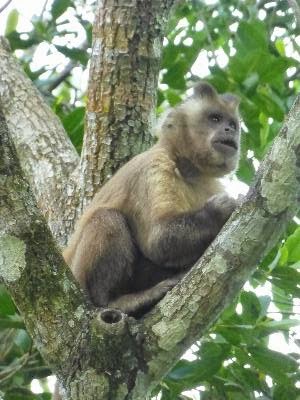
Next, one of the monkeys that popped in to get a free feed in the morning.
Then,  H fixing the burst oil line,  on the plaza of Bonito.
And finally,  the beautiful pair of Macaws. They mate for life.

Swimming in a big natural aquarium: full of big fish!

After Campo Grande, our next Brazilian stop was Bonito. And, it wasn't even a place we'd heard of until Brazilians started telling us about it. 

Bonito is known for crystal clear rivers which have about 30 different types of fish in them: from itty bitty tiny ones, to big fish (I think about 1 metre long, although the biggest we saw would have been about 50cm). And, to see these fish, you simply jump in with a snorkel and mask and let the current take you down stream!

On our first night we were lucky enough to have chosen to stay at 'Camping Gordo'. Lucky, because we were the only people there and because it is such a beautiful river, and lovely campsite. 

We are travelling with our own snorkelling gear so, having arrived late, we didn't waste time: we jumped straight in. We loved looking at all the fish and while H sat in the water looking through his mask I threw biscuit crumbs in front of him (from a bridge above) to bring fish right up to his face! He did the same for me the next morning. 

The next morning we also discovered even better treats at Camping Gordo: the staff put feed into trays beside the river, and the monkeys came for a feed! This time it was the monkeys, perched on a branch above the river, who dropped feed into the river for the fish. 

Then, H went for a walk and discovered the extremities of Camping Gordo, and just how much further we could snorkel. So, twice I went with H: we hiked to the furtherest place and snorkelled the longer distance. We saw even more varieties of fish. 

In the camping area we also saw lots of bird life, from woodpeckers, toucans, parrots, and big goose-turkey types things, as well as a big iguana (lizard), and a rodent which I'm not sure of the name of. 

The following 2 nights in Bonito we passed at the municipal camp ground (Camping Rio Formoso), just because it was closer to town. It also had river access for snorkelling, but not as good,easy, or extensive. There were also some motorcycle overlanders (Germans living in New Zealand), and it was nice to have chatted with them. 

Engine Trouble again!
When H had replaced the oil line in the engine (just a few days earlier), he bought what he could in the small town he'd bussed it to. But, alas, it wasn't strong enough. It did well over 1000 kilometres, and then it burst as we entered the the town of Bonito. 

We were lucky, H discovered the problem immediately. He saw the red oil light come on on the dash and pulled over straight away: said he'd never seen the light come on before. And, as we pulled over, a motorcyclist pulled up to the drivers window to tell us we were spilling oil. 

H popped the bonnet and discovered that we'd just leaked out all 7 litres of oil within 300 metres of the city centre of Bonito. We half expected that we'd be told we had to go somewhere for repairs as I'd read that Bonito is an ecological place. But, clearly, it's a South American standard; the environmental police drove past and didn't even stop. 

So, with no other option that we knew how to pursue, H went and bought more oil, a new (better) hose, and fixed it right there on the street beside the city plaza. Practice makes perfect: he was much quicker this time. 

The next day we had the engine cleaned. For less than $20 we got the car up above a pit where they cleaned the engine from above and below. It came up amazingly clean (like new!), but wow the chemical smelled toxic. 

Choosing a tour in Bonito
You could spend a lot money doing tours in Bonito. We didn't. All tours must be booked in an agency in town, and they all offer the same tours at the same prices. They don't offer Camping Gordo. 

We felt that we'd seen a lot of fish and had a good experience at Camping Gordo, so we decided not to go on a flotation tour (which is snorkelling in a river to see fish). The price difference is massive: Rs35/person camping, or about Rs130/p for flotation tour. 

We did book a tour to see the Gruta da Lago Azul. It's a cave which you hike into (in tour groups) to see a spectacular blue lake at the bottom of. It was lovely, and it's considered the postcard picture of Bonito. 
Our only disappointment in the tour was that it took so long! It could have been 30 minutes, but they dragged it out over 1.5 hours as the guide gave a lot of explanation about safety, and the features of the cave: all in Portuguese, so I didn't understand most of it (if the safety talk was so needed shouldn't they have given us something in English or checked that we understood?). 
Anyway, we did like the blue lake, just not the tour. 

On driving away from Grutas da Lago Azul we saw, at very close range, two red macaws (I think this makes them Scarlett Macaws) sitting in a tree. They are absolutely spectacular birds and we got some nice photos (yes, I'll upload when I can attach my tablet to wifi!)